
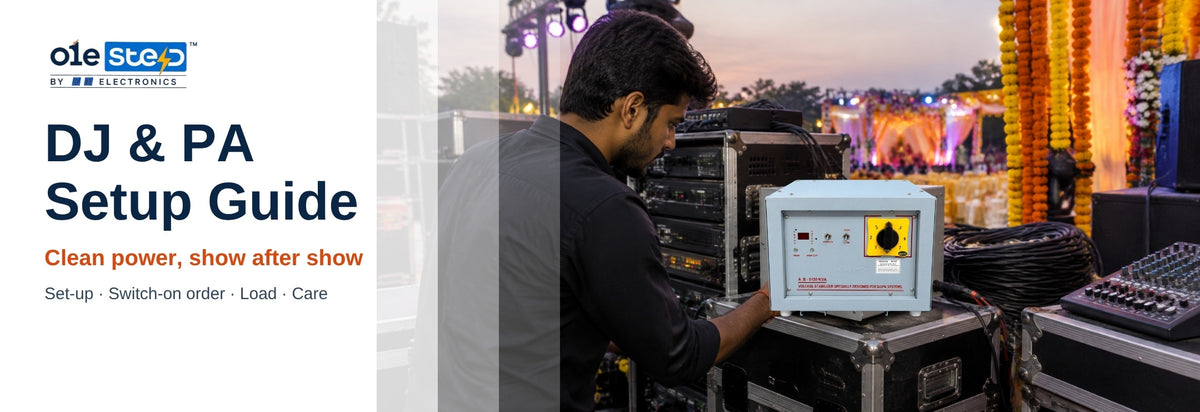
Wedding baraats, sangeet nights, melody programmes and open-ground shows often run on a long cable from the nearest pole or a shared generator. The voltage keeps changing as lights and loads come and go. A DJ and PA stabilizer keeps your sound system close to 220 V, so the music stays clean and the amplifiers stay safe.
How a manual DJ stabilizer works
O1e Step DJ stabilizers use a heavy aluminium-wound transformer with several output steps. The operator watches the voltage meter and turns the selector to the step that gives an output close to 220 V. Because you choose the step, the stabilizer reacts the way you want even when the supply jumps around.
- ABDJ-5130: 8-step voltage control, current control and a digital meter.
- ABDJ2-5130 and ABDJ2-5190: rotary selector, bypass and high/low switches, and 6 output sockets at the rear.
- AB-PD4: a 4-socket distribution box with a live voltage meter to share the stabilized power across your rack.
Setting up at the venue
- Place it right. Keep the stabilizer on a flat, dry surface or rack shelf, off the ground, away from rain, drinks and generator exhaust.
- Check the supply first. Connect the input and read the incoming voltage on the meter before connecting any equipment.
- Set the output. Turn the selector until the output reads close to 220 V.
- Switch on in order. Stabilizer first, then mixer and other low-power gear, and amplifiers last. Switch off in the reverse order.
- Distribute neatly. Use the rear sockets or an AB-PD4 box instead of loose multi-plugs.
- Keep watching. Glance at the meter during the show and adjust the step if the supply drifts.
Load check: add up the wattage of your amplifiers and lights and keep the total within the stabilizer rating. If you are not sure, ask us on WhatsApp before the event.
Care between shows
- Carry the unit upright in a padded case; transformers are heavy and do not like knocks.
- Wipe off dust and moisture after outdoor events and let it dry before storing.
- Inspect the input cable, plugs and sockets for cuts, loose pins or heat marks.
- Store it in a dry place, not on a damp floor.
Troubleshooting
| What you notice | What it usually means | What to do |
|---|---|---|
| Hum or buzz in speakers | Low output voltage or poor earthing | Raise the step until the output reads close to 220 V and check the earth connection. |
| Amplifiers switch off during the show | Voltage too low or overload | Check the meter, adjust the step and reduce the load if needed. |
| Meter reading jumps a lot | Unsteady venue supply | Stay close to the stabilizer and adjust as needed. Ask the organiser for a dedicated line if possible. |
| Very hot body or burning smell | Overload or fault | Switch off at once, disconnect the load and contact O1e Step support. |
Benefits
- Clean sound without voltage-related hum and dropouts.
- Longer life for amplifiers, mixers and lights.
- Confidence at every booking, whatever the venue supply.
Warranty and support
3 years on the transformer and 2 years on other parts. WhatsApp +91 98117 81217 or email supports@o1estep.com.